



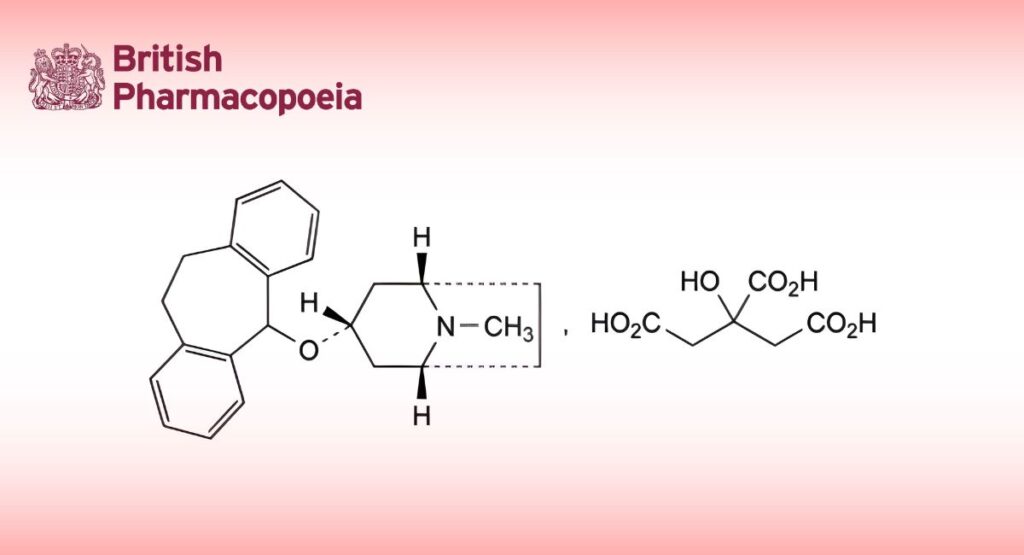
(Ph. Eur. monograph 1308)
C29H35NO8 525.6 2169-75-7
Action and use
Histamine H1 receptor antagonist; anticholinergic.
DEFINITION
Deptropine citrate contains not less than 98.0 per cent and not more than the equivalent of 101.0 per cent of (1R,3r,5S)-3-(10,11-dihydro-5H-dibenzo[a,d][7]annulen-5-yloxy)-8-methyl-8-azabicyclo[3.2.1]octane dihydrogen citrate, calculated with reference to the dried substance.
CHARACTERS
A white or almost white, microcrystalline powder, very slightly soluble in water and in anhydrous ethanol, practically
insoluble in methylene chloride. It melts at about 170 °C, with decomposition.
IDENTIFICATION
First identification: A.
Second identification: B, C, D, E.
A. Examine by infrared absorption spectrophotometry (2.2.24), comparing with the spectrum obtained with deptropine citrate CRS.
B. Examine the chromatograms obtained in the test for related substances. The principal spot in the chromatogram
obtained with test solution (b) is similar in position, colour and size to the principal spot in the chromatogram obtained with reference solution (b).
C. To about 1 mg add 0.5 mL of sulfuric acid R. A stable red-orange colour develops.
D. Dissolve about 1 mg in 0.25 mL of perchloric acid R and warm gently until the solution becomes turbid. Add 5 mL of glacial acetic acid R; a pink colour with an intense green fluorescence appears.
E. To about 5 mg add 1 mL of acetic anhydride R and 5 mL of pyridine R. A purple colour develops.
TESTS
pH (2.2.3)
Suspend 0.25 g in carbon dioxide-free water R, dilute to 25 mL with the same solvent and filter. The pH of the solution is 3.7 to 4.5.
Related substances
Examine by thin-layer chromatography (2.2.27), using as the coating substance a suitable silica gel with a fluorescent indicator having an optimal intensity at 254 nm.
Test solution (a): Dissolve 0.10 g of the substance to be examined in methanol R and dilute to 10 mL with the same
solvent.
Test solution (b): Dilute 1 mL of test solution (a) to 10 mL with methanol R.
Reference solution (a): Dilute 1.0 mL of test solution (a) to 100.0 mL with methanol R.
Reference solution (b): Dissolve 20 mg of deptropine citrate CRS in methanol R and dilute to 2 mL with the same solvent. Dilute 1 mL of the solution to 10 mL with methanol R.
Reference solution (c): Dissolve 5 mg of tropine CRS in methanol R and dilute to 100.0 mL with the same solvent.
Reference solution (d): Dissolve 10 mg of deptropine citrate CRS and 10 mg of tropine CRS in methanol R and dilute to 25 mL with the same solvent.
Apply to the plate 40 μL of each solution. Develop over a path of 10 cm using a mixture of 8 volumes of concentrated ammonia R and 92 volumes of butanol R. Dry the plate at 100 °C to 105 °C until the ammonia has completely evaporated. Examine in ultraviolet light at 254 nm. Any spot in the chromatogram obtained with test solution (a), apart from the principal spot, is not more intense than the spot in the chromatogram obtained with reference solution (a) (1 per cent). Spray with dilute potassium iodobismuthate solution R and then with a 10 g/L solution of sodium nitrite R. Expose the plate to iodine vapours. Examine in daylight and in ultraviolet light at 254 nm. In the chromatogram obtained with test solution (a): any spot corresponding to tropine is not more intense than the spot in the chromatogram obtained with reference solution (c) (0.5 per cent); any spot, apart from the principal spot and any spot corresponding to tropine, is not more intense than the spot in the chromatogram obtained with reference solution (a) (1 per cent). The test is not valid unless the chromatogram obtained with reference solution (d) shows two clearly separated spots.
Loss on drying (2.2.32)
Not more than 2.0 per cent, determined on 1.000 g by drying in an oven at 105 °C for 4 h.
Sulfated ash (2.4.14)
Not more than 0.1 per cent, determined on 1.0 g.
ASSAY
Dissolve 0.400 g in 50 mL of anhydrous acetic acid R. Titrate with 0.1 M perchloric acid, determining the end-point
potentiometrically (2.2.20).
1 mL of 0.1 M perchloric acid is equivalent to 52.56 mg of C29H35NO8.
STORAGE
Store protected from light.
IMPURITIES
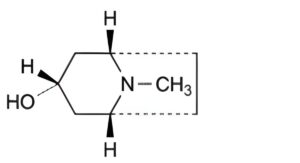
A. (1R,3r,5S)-8-methyl-8-azabicyclo[3.2.1]octan-3-ol (tropine),
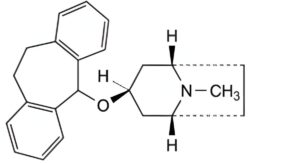
B. (1R,3s,5S)-3-(10,11-dihydro-5H-dibenzo[a,d][7]annulen-5-yloxy)-8-methyl-8-azabicyclo[3.2.1]octane
(pseudodeptropine),
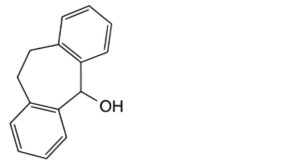
C. 10,11-dihydro-5H-dibenzo[a,d][7]annulen-5-ol (dibenzocycloheptadienol),
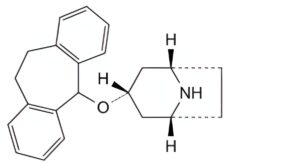
D. (1R,3r,5S)-3-(10,11-dihydro-5H-dibenzo[a,d][7]annulen-5-yloxy)-8-azabicyclo[3.2.1]octane (demethyldeptropine).


