



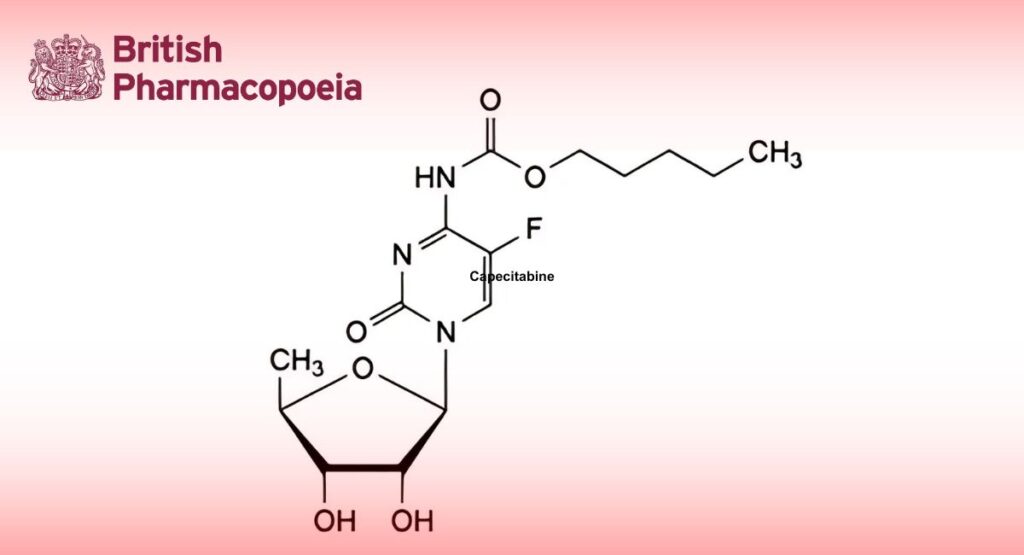
(Ph. Eur. monograph 2762)
C15H22FN3O6 359.3 154361-50-9
Action and use
Pyrimidine analogue; cytotoxic; treatment of colorectal cancer.
Preparation
Capecitabine Tablets
DEFINITION
Pentyl [1-(5-deoxy-β-D-ribofuranosyl)-5-fluoro-2-oxo-1,2-dihydropyrimidin-4-yl]carbamate.
Content
98.0 per cent to 102.0 per cent (anhydrous substance).
CHARACTERS
Appearance
White or almost white powder.
Solubility
Sparingly soluble in water, freely soluble in anhydrous ethanol, practically insoluble in heptane.
IDENTIFICATION
A. Specific optical rotation (see Tests).
B. Infrared absorption spectrophotometry (2.2.24).
Comparison: capecitabine CRS.
TESTS
Specific optical rotation (2.2.7)
+ 96.0 to + 100.0 (anhydrous substance).
Dissolve 0.250 g in methanol R and dilute to 25.0 mL with the same solvent.
Related substances
Liquid chromatography (2.2.29). Prepare the solutions immediately before use or store them at 2-8 °C.
Solvent mixture: acetonitrile R, methanol R, water R (5:35:60 V/V/V).
Test solution: Dissolve 60.0 mg of the substance to be examined in 80 mL of the solvent mixture, sonicate until dissolution is complete and dilute to 100.0 mL with the solvent mixture.
Reference solution (a): Dissolve 60.0 mg of capecitabine CRS in 80 mL of the solvent mixture, sonicate until dissolution is complete and dilute to 100.0 mL with the solvent mixture.
Reference solution (b): Dilute 1.0 mL of the test solution to 100.0 mL with the solvent mixture. Dilute 1.0 mL of this solution to 20.0 mL with the solvent mixture.
Reference solution (c): Dissolve 3 mg of capecitabine impurity A CRS, 3 mg of capecitabine impurity B CRS and 5 mg of capecitabine impurity D CRS in 80 mL of the solvent mixture, sonicate until dissolution is complete and dilute to 100.0 mL with the solvent mixture. Dilute 1 mL of the solution to 50 mL with the test solution.
Column:
— size: l = 0.25 m, Ø = 4.6 mm;
— stationary phase: end-capped octadecylsilyl silica gel for chromatography R (5 μm);
— temperature: 40 °C.
Mobile phase:
— mobile phase A: acetonitrile R, methanol R, 0.1 per cent V/V solution of glacial acetic acid R (5:35:60 V/V/V);
— mobile phase B: acetonitrile R, 0.1 per cent V/V solution of glacial acetic acid R, methanol R (5:15:80 V/V/V);
| Time (min) |
Mobile phase A (per cent V/V) |
Mobile phase B (per cent V/V) |
| 0 – 5 | 100 | 0 |
| 5 – 20 | 100 → 49 | 0 → 51 |
| 20 – 30 | 49 | 51 |
Flow rate: 1.0 mL/min.
Detection: Spectrophotometer at 250 nm.
Injection: 10 μL of the test solution and reference solutions (b) and (c).
Identification of impurities: Use the chromatogram obtained with reference solution (c) to identify the peaks due to impurities A, B and D.
Relative retention: With reference to capecitabine (retention time = about 17 min): impurity A = about 0.18; impurity B = about 0.19; impurities D and E = about 0.95.
System suitability: Reference solution (c):
— resolution: minimum 1.5 between the peaks due to impurities A and B; minimum 2.0 between the peaks due to impurity D and capecitabine.
Calculation of percentage contents:
— for each impurity, use the concentration of capecitabine in reference solution (b);
— correction factor: multiply the peak area of impurity B by 1.3.
Limits:
— impurities A, B: for each impurity, maximum 0.3 per cent;
— sum of impurities D and E: maximum 0.2 per cent;
— unspecified impurities: for each impurity, maximum 0.05 per cent;
— total: maximum 0.5 per cent;
— reporting threshold: 0.03 per cent.
Water (2.5.32)
Maximum 0.3 per cent.
Inject 1.0 mL of a 0.200 g/mL solution of the substance to be examined in methanol R.
Sulfated ash (2.4.14)
Maximum 0.1 per cent, determined on 1.0 g in a platinum crucible.
ASSAY
Liquid chromatography (2.2.29) as described in the test for related substances with the following modification.
Injection: Test solution and reference solution (a).
Calculate the percentage content of C15H22FN3O6 taking into account the assigned content of capecitabine CRS.
IMPURITIES
Specified impurities: A, B, D, E.
Other detectable impurities (the following substances would, if present at a sufficient level, be detected by one or other of the tests in the monograph. They are limited by the general acceptance criterion for other/unspecified impurities and/or by the general monograph Substances for pharmaceutical use (2034). It is therefore not necessary to identify these impurities for demonstration of compliance. See also 5.10. Control of impurities in substances for pharmaceutical use) C, F, G.
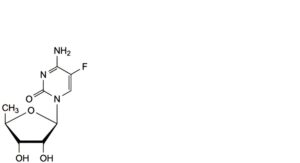
A. 4-amino-1-(5-deoxy-β-D-ribofuranosyl)-5-fluoropyrimidin-2(1H)-one (5ʹ-deoxy-5-fluorocytidine),
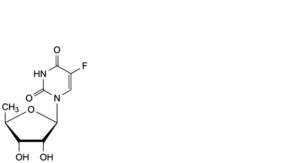
B. 1-(5-deoxy-β-D-ribofuranosyl)-5-fluoropyrimidine-2,4(1H,3H)-dione (5ʹ-deoxy-5-fluorouridine),
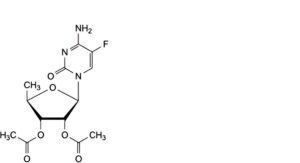
C. 1-(2,3-di-O-acetyl-5-deoxy-β-D-ribofuranosyl)-4-amino-5-fluoropyrimidin-2(1H)-one,
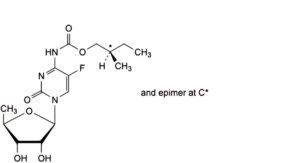
D. (2RS)-2-methylbutyl [1-(5-deoxy-β-D-ribofuranosyl)-5-fluoro-2-oxo-1,2-dihydropyrimidin-4-yl]carbamate,
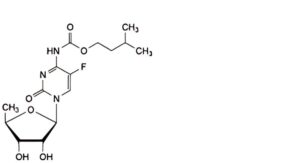
E. 3-methylbutyl [1-(5-deoxy-β-D-ribofuranosyl)-5-fluoro-2-oxo-1,2-dihydropyrimidin-4-yl]carbamate,
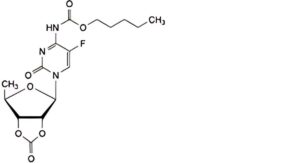
F. pentyl [5-fluoro-1-[(3aR,4R,6R,6aR)-6-methyl-2-oxotetrahydrofuro[3,4-d][1,3]dioxol-4-yl]-2-oxo-1,2-dihydropyrimidin-4-yl]carbamate,
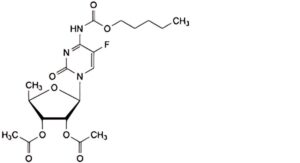
G. pentyl [1-(2,3-di-O-acetyl-5-deoxy-β-D-ribofuranosyl)-5-fluoro-2-oxo-1,2-dihydropyrimidin-4-yl]carbamate.


