



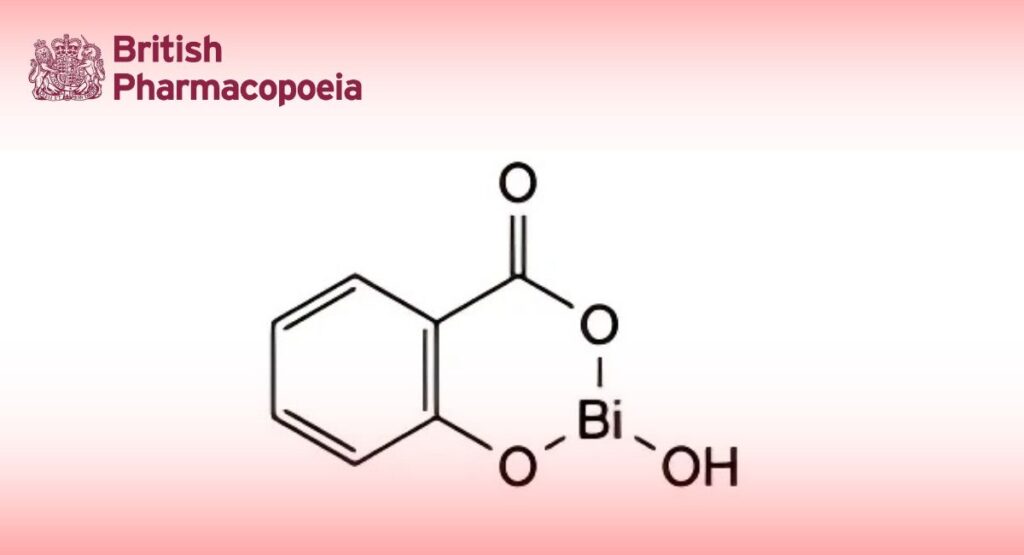
(Ph. Eur. monograph 1495)
C7H5BiO4 362.1 14882-18-9
DEFINITION
2-Hydroxy-2H,4H-1,3,2-benzodioxabismin-4-one. Complex of bismuth and salicylic acid.
Content
56.0 per cent to 59.4 per cent of Bi (Ar 209.0) (dried substance).
CHARACTERS
Appearance
White or almost white powder.
Solubility
Practically insoluble in water and in ethanol (96 per cent). It dissolves in mineral acids with decomposition.
IDENTIFICATION
A. To 0.5 g add 10 mL of hydrochloric acid R1. Heat on a water-bath for 5 min. Cool and filter. Retain the filtrate for identification test B. Wash the residue with dilute hydrochloric acid R and then with water R. Dissolve the residue in 0.5-1 mL of dilute sodium hydroxide solution R. Add 15 mL of water R. Neutralise with dilute hydrochloric acid R. The solution gives reaction (a) of salicylates (2.3.1).
B. The filtrate obtained in identification test A gives reaction (b) of bismuth (2.3.1).Bismuth Subsalicylate
TESTS
Acidity
Shake 2.0 g with 30 mL of ether R for 1 min and filter. To the filtrate add 30 mL of ethanol (96 per cent) R and 0.1 mL of thymol blue solution R. Not more than 0.35 mL of 0.1 M sodium hydroxide is required to change the colour of the indicator to blue.
Chlorides (2.4.4)
Maximum 200 ppm.
Dissolve 0.250 g in a mixture of 2 mL of nitric acid R, 5 mL of water R and 8 mL of methanol R.
Nitrates
Maximum 0.4 per cent.
To 0.1 g add 10 mL of water R and, with caution, 20 mL of sulfuric acid R and stir. The solution is not more intensely yellow coloured than a reference solution prepared at the same time using 0.1 g of salicylic acid R, 6 mL of water R, 4 mL of nitrate standard solution (100 ppm NO3) R and 20 mL of sulfuric acid R.
Soluble bismuth
Maximum 40 ppm.
Atomic absorption spectrometry (2.2.23, Method I).
Test solution: Suspend 5.0 g in 100 mL of water R. Stir constantly for 2 h at 20-23 °C. Filter through filter paper (slow filtration) then through a cellulose micropore membrane filter (0.1 μm). To 10.0 mL of clear filtrate, add 0.1 mL of nitric acid R.
Reference solutions: Prepare the reference solutions using bismuth standard solution (100 ppm Bi) R and diluting with a mixture of equal volumes of dilute nitric acid R and water R.
Source: Bismuth hollow-cathode lamp.
Wavelength: 223.06 nm.
Atomisation device: Air-acetylene flame.
Loss on drying (2.2.32)
Maximum 1.0 per cent, determined on 1.000 g by drying in an oven at 105 °C.
ASSAY
Dissolve with heating 0.300 g in 10 mL of a mixture of 2 volumes of perchloric acid R and 5 volumes of water R. To the hot solution, add 200 mL of water R and 50 mg of xylenol orange triturate R. Titrate with 0.1 M sodium edetate until a yellow colour is obtained.
1 mL of 0.1 M sodium edetate is equivalent to 20.90 mg of Bi.
STORAGE
Protected from light.


