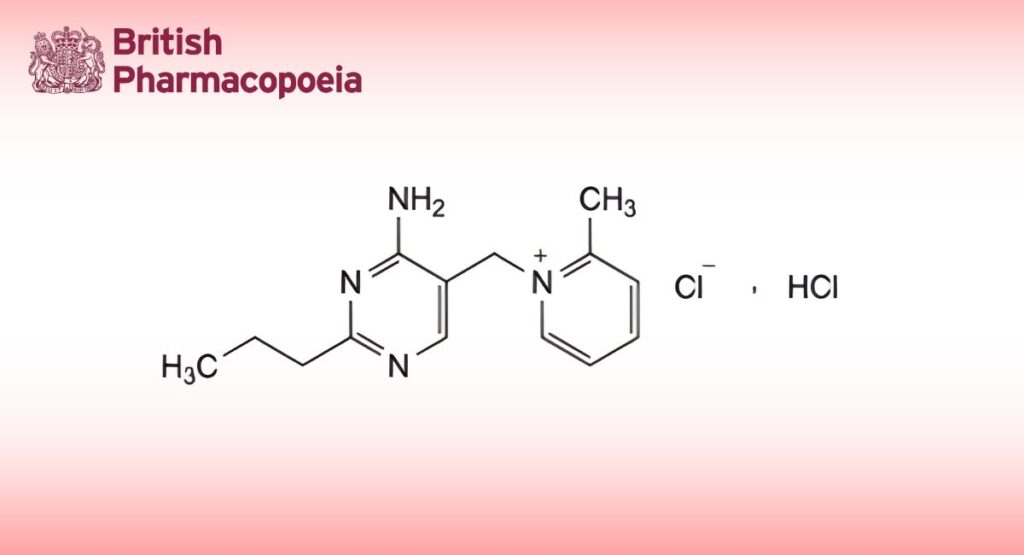
(Amprolium Hydrochloride for Veterinary use, Ph. Eur. monograph 3010)
C14H20Cl2N4 315.2 137-88-2
Action and use
Antiprotozoal; prevention and treatment of coccidiosis (veterinary)
DEFINITION
1-[(4-Amino-2-propylpyrimidin-5-yl)methyl]-2-methylpyridin-1-ium chloride hydrochloride.
Content
97.5 per cent to 102.0 per cent (dried substance).
CHARACTERS
Appearance
White or almost white powder.
Solubility
Freely soluble in water, slightly soluble in ethanol (96 per cent), practically insoluble in heptane.
IDENTIFICATION
A. Infrared absorption spectrophotometry (2.2.24).
Comparison: amprolium hydrochloride CRS.
B. It gives reaction (a) of chlorides (2.3.1).
TESTS
Appearance of solution
The solution is clear (2.2.1) and not more intensely coloured than reference solution BY5 (2.2.2, Method II).
Dissolve 0.5 g in 50 mL of water R.
Related substances
Liquid chromatography (2.2.29).
Solution A: Buffer solution A, mobile phase (12.5:87.5 V/V).
Buffer solution A: Dissolve 6.8 g of potassium dihydrogen phosphate R in about 900 mL of water R, adjust to pH 7.0 with dilute sodium hydroxide solution R and dilute to 1000 mL with water R.
Buffer solution B: Dissolve 1.2 g of sodium hexanesulfonate R and 3.0 g of ammonium acetate R in about 900 mL of water for chromatography R, adjust to pH 3.5 with glacial acetic acid R and dilute to 1000 mL with water for chromatography R.
Test solution (a): Dissolve 75.0 mg of the substance to be examined in solution A and dilute to 10.0 mL with solution A.
Test solution (b): Dilute 4.0 mL of test solution (a) to 30.0 mL with solution A. Dilute 1.0 mL of this solution to 10.0 mL with solution A.
Reference solution (a): Dilute 1.0 mL of test solution (a) to 10.0 mL with solution A. Dilute 1.0 mL of this solution to 50.0 mL with solution A.
Reference solution (b): Dissolve 10.0 mg of amprolium hydrochloride CRS in solution A and dilute to 100.0 mL with solution A.
Reference solution (c): Dissolve 12 mg of 2-methylpyridine R (impurity A) in 1 mL of test solution (a) and dilute to 100 mL with solution A.
Column:
— size: l = 0.15 m, Ø = 4.6 mm;
— stationary phase: end-capped octylsilyl silica gel for chromatography R (5 μm);
— temperature: 30 °C.
Mobile phase: 2-propanol R1, methanol R1, buffer solution B (5:10:85 V/V/V).
Flow rate: 1.0 mL/min.
Detection: Spectrophotometer at 247 nm.
Injection: 5 μL of test solution (a) and reference solutions (a) and (c).
Run time: 3.0 times the retention time of amprolium.
Identification of impurities: Use the chromatogram obtained with reference solution (c) to identify the peak due to impurity A.
Relative retention: With reference to amprolium (retention time = about 8 min): impurity A = about 0.3.
System suitability Reference solution (c):
— resolution: minimum 10.0 between the peaks due to impurity A and amprolium.
Calculation of percentage contents:
— correction factor: multiply the peak area of impurity A by 1.6;
— for each impurity, use the concentration of amprolium hydrochloride in reference solution (a).
Limits:
— impurity A: maximum 0.7 per cent;
— unspecified impurities: for each impurity, maximum 0.20 per cent;
— total: maximum 1.0 per cent;
— reporting threshold: 0.10 per cent.
Loss on drying (2.2.32)
Maximum 1.0 per cent, determined on 1.000 g by drying in an oven at 110 °C.
Sulfated ash (2.4.14)
Maximum 0.1 per cent, determined on 1.0 g.
ASSAY
Liquid chromatography (2.2.29) as described in the test for related substances with the following modification.
Injection Test solution (b) and reference solution (b).
Calculate the percentage content of C14H20Cl2N4 taking into account the assigned content of amprolium hydrochloride CRS.
IMPURITIES
Specified impurities A.
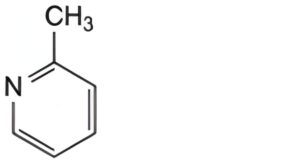
A. 2-methylpyridine.