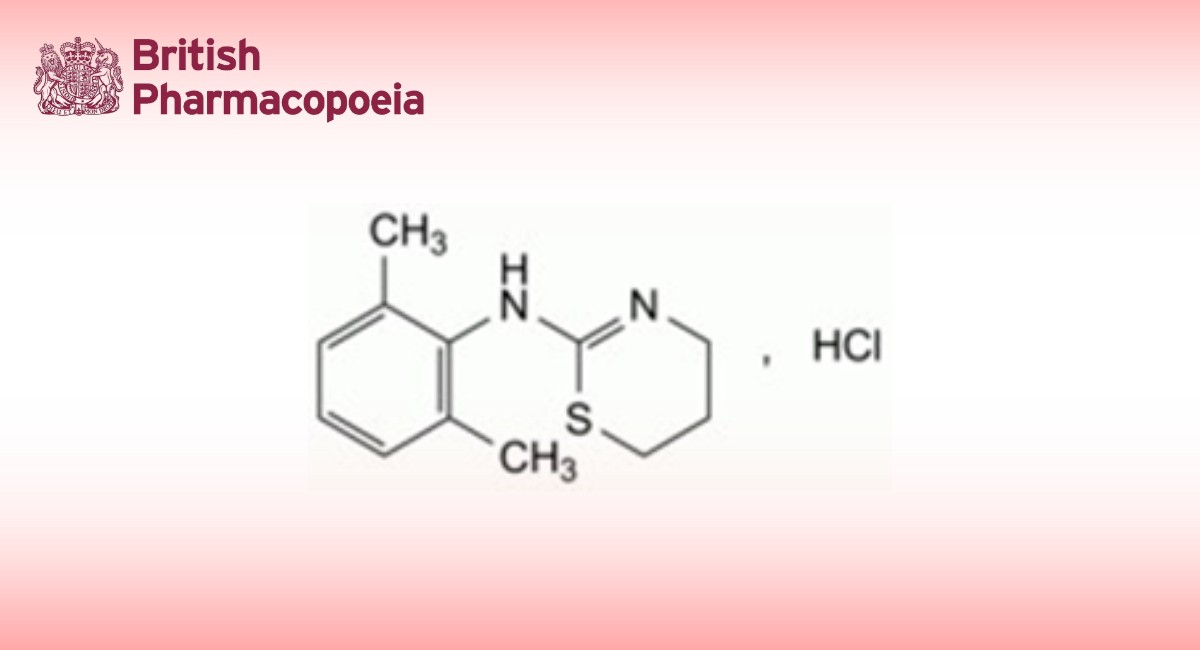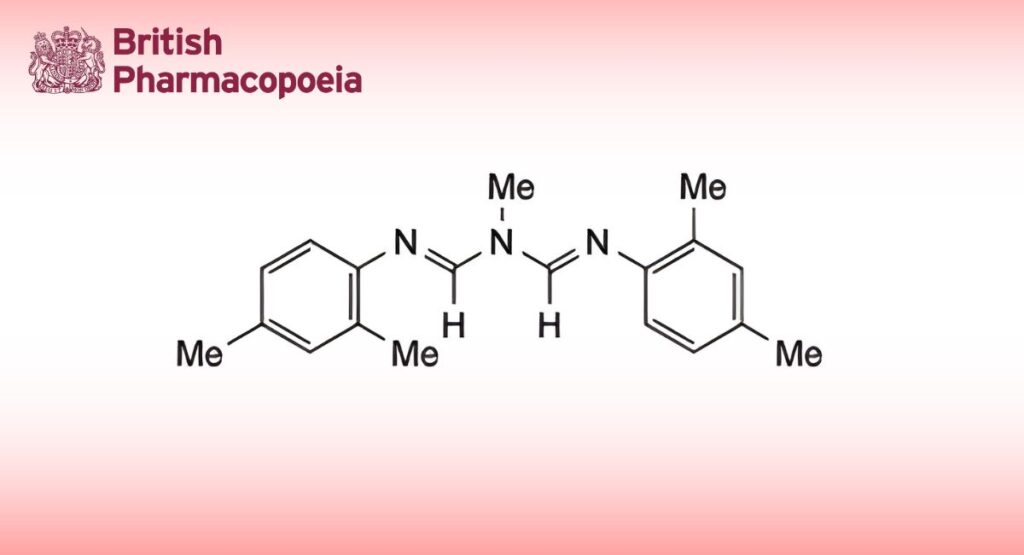
C19H23N3 293.4 33089-61-1
Action and use
Topical parasiticide; acaricide.
Preparation
Amitraz Dip Concentrate (Liquid)
DEFINITION
Amitraz is N-methylbis (2,4-xylyliminomethyl) amine. It contains not less than 97.0% and not more than 101.0% of C19H23N3, calculated with reference to the anhydrous substance.
CHARACTERISTICS
A white to buff powder.
Practically insoluble in water; decomposes slowly in ethanol (96%); freely soluble in acetone.
IDENTIFICATION
The infrared absorption spectrum, Appendix II A, is concordant with the reference spectrum of amitraz (RSV 04).
TESTS
Related substances
Carry out the method for gas chromatography, Appendix III B, using the following solutions.
0.010% w/v of 2,4-dimethylaniline, 0.20% w/v of form-2′,4′-xylidide BPCRS and 0.20% w/v of N,N′-bis(2,4-xylyl)formamidine BPCRS in methyl acetate (solution A)
Disperse 30 mg of N-methyl-N′-(2,4-xylyl)formamidine hydrochloride BPCRS in 5 mL of methyl acetate, add about 32 mg of triethylamine, mix with the aid of ultrasound for 2 minutes, filter, wash the filter with a small amount of methyl acetate and add sufficient methyl acetate to the combined filtrate and washings to produce 25 mL (solution B) (about 0.1% w/v of N-methyl-N′- (2,4-xylyl)formamidine).
(1) 5.0% w/v solution of the substance being examined in methyl acetate.
(2) A mixture of equal volumes of solution A and solution B.
CHROMATOGRAPHIC CONDITIONS
(a) Use a fused silica capillary column (10 m × 0.53 mm) bonded with a film (5 μm) of poly [methyl(95)phenyl(5)]siloxane (Chrompack CP-SIL 8 CB is suitable).
(b) Use helium as the carrier gas at 12 mL per minute.
(c) Use gradient conditions at an initial temperature of 125°, maintained at 125° for 5 minutes, increasing linearly to 270° at a rate of 5° per minute and maintained at 270° for 15 minutes.
(d) Use an inlet temperature of 230°.
(e) Use a flame ionisation detector at a temperature of 300°.
(f) Inject 1 μL of each of solutions (1) and (2).
In the chromatogram obtained with solution (2) the peaks following the solvent peak, in order of emergence, are due to 2,4-dimethylaniline, form-2′,4′-xylidide, N-methyl-N′-(2,4- xylyl)formamidine and N,N′-bis(2,4-xylyl)formamidine.
LIMITS
In the chromatogram obtained with solution (1):
the area of any peak corresponding to 2,4-dimethylaniline, form-2′,4′-xylidide, N-methyl-N′-(2,4- xylyl)formamidine and N,N′-bis(2,4-xylyl)formamidine is not greater than the area of the corresponding peak in the chromatogram obtained with solution (2) (0.1%, 2%, 1% and 2% respectively);
the area of any other secondary peak is not greater than the area of the peak due to 2,4- dimethylaniline in the chromatogram obtained with solution (2) (0.1%).
Water
Not more than 0.1% w/w, Appendix IX C, Method IA. Use 5 g and a mixture of equal volumes of chloroform and 2-chloroethanol in place of anhydrous methanol.
Sulfated ash
Not more than 0.2%, Appendix IX A.
ASSAY
Carry out the method for gas chromatography, Appendix III B, using the following solutions.
Prepare a 2% v/v solution of squalane (internal standard) in methyl acetate (solution C).
(1) 0.15 g of the substance being examined in sufficient methyl acetate to produce 30 mL.
(2) 0.15 g of the substance being examined in 10 mL of solution C and add sufficient methyl acetate to produce 30 mL.
(3) 1.50% w/v solution of amitraz BPCRS in solution C and dilute 1 volume of this solution to 3 volumes with methyl acetate.
CHROMATOGRAPHIC CONDITIONS
(a) Use a fused silica capillary column (15 m × 0.53 mm) coated with a 1.5 μm film of methyl silicone gum (Chrompack CP-Sil 5 CB is suitable).
(b) Use helium as the carrier gas at 12 mL per minute.
(c) Use isothermal conditions maintained at 220°.
(d) Use an inlet temperature of 230°.
(e) Use a flame ionisation detector at a temperature of 300°.
(f) Inject 1 μL of each solution.
SYSTEM SUITABILITY
The assay is not valid unless, in the chromatogram obtained with solution (3), the resolution factor between the peaks corresponding to squalane and amitraz is at least 3.0.
LIMITS
Calculate the content o fC19H23N3 from the chromatograms obtained using the declared content of C19H23N3 in amitraz BPCRS.
STORAGE
Amitraz should be kept in a well-closed container, which may contain paraformaldehyde, packed in separate sachets as a stabiliser.
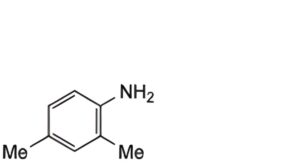
A. 2,4-dimethylaniline (2,4-xylidine),
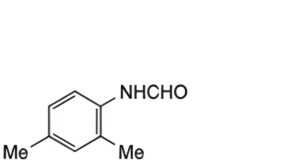
B. form-2′,4′-xylidide,
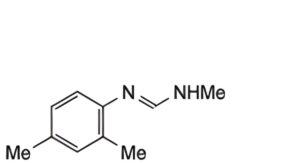
C. N-methyl-N′-(2,4-xylyl)formamidine,
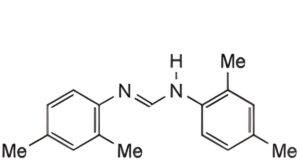
D. N,N′-bis(2,4-xylyl)formamidine.