Edition: BP 2025 (Ph. Eur. 11.6 update)
Action and use
Adrenoceptor agonist.
DEFINITION
Adrenaline Injection is a sterile, isotonic solution containing either 0.18% w/v of Adrenaline Acid Tartrate or 0.1% w/v of Adrenaline in Water for Injections.
The injection complies with the requirements stated under Parenteral Preparations and with the following requirements.
Content of adrenaline, C9H13NO3
0.0900 to 0.1150% w/v, of which at least 0.0850% w/v is L-adrenaline.
CHARACTERISTICS
A colourless or almost colourless solution.
IDENTIFICATION
A. In the Assay, the principal peak in the chromatogram obtained with solution (1) has the same retention time as that in the chromatogram obtained with solution (2).
B. To 10 mL of the injection add 2 mL of a 10% w/v solution of disodium hydrogen orthophosphate and sufficient iodinated potassium iodide solution to produce a brown colour and remove excess iodine by adding 0.1M sodium thiosulfate drop wise. A red colour is produced.
TESTS
Acidity
pH, 2.8 to 4.0, Appendix V L.
Related substances
The total of all impurities from methods A and B is not more than 19.0%.
A. Carry out the method for liquid chromatography, Appendix III D, using the following solutions in the mobile phase. Prepare the solutions immediately before use and protect from light. Store and inject the solutions at 4°, using a cooled autosampler.
(1) Dilute the injection to produce a solution containing the equivalent of 0.005% w/v of Adrenaline.
(2) Dilute 3 volumes of solution (1) to 20 volumes.
(3) 0.005% w/v of (±)-adrenaline hydrochloride.
CHROMATOGRAPHIC CONDITIONS
(a) Use a stainless steel column (15 cm × 4.6 mm) packed with β-cyclodextrin hydroxypropyl ether derivative for chiral chromatography (3 μm) (ORpak CDBS-453 Chiral is suitable).
(b) Use isocratic elution and the mobile phase described below.
(c) Use a flow rate of 0.7 mL per minute.
(d) Use a column temperature of 10°.
(e) Use a detection wavelength of 280 nm.
(f) Inject 20 μL of each solution.
MOBILE PHASE
1 volume of a solution containing 0.2M potassium chloride and 0.4% v/v of glacial acetic acid, 3 volumes of acetonitrile and 96 volumes of 0.2M potassium chloride.
When the chromatograms are recorded under the prescribed conditions, the retention time of D-adrenaline (impurity 1) relative to L-adrenaline (retention time about 13 minutes) is about 1.1.
SYSTEM SUITABILITY
The test is not valid unless, in the chromatogram obtained with solution (3), the resolution between the two principal peaks is at least 2.0.
LIMITS
In the chromatogram obtained with solution (1), the area of any peak corresponding to D-adrenaline (impurity 1) is not greater than the sum of the areas of the peaks due to L-adrenaline and D-adrenaline in the chromatogram obtained with solution (2) (15%).
B. Carry out the method for liquid chromatography, Appendix III D, using the following solutions prepared protected from light.
(1) The preparation being examined.
(2) Dilute 1 volume of solution (1) to 10 volumes with the mobile phase.
(3) Dilute 1 volume of solution (2) to 10 volumes with the mobile phase.
(4) 0.1% w/v of adrenaline impurity standard BPCRS in the mobile phase.
(5) Dilute 1 volume of solution (3) to 10 volumes with the mobile phase.
CHROMATOGRAPHIC CONDITIONS
(a) Use a stainless steel column (25 cm × 4.6 mm) packed with end-capped octadecylsilyl silica gel for chromatography (5 μm) (Zorbax Eclipse Plus C18 is suitable).
(b) Use isocratic elution and the mobile phase described below.
(c) Use a flow rate of 1.5 mL per minute.
(d) Use an ambient column temperature.
(e) Use a detection wavelength of 280 nm.
(f) Inject 20 μL of each solution.
(g) Allow the chromatography to proceed for 4 times the retention time of adrenaline.
MOBILE PHASE
5 volumes of methanol and 95 volumes of a solution containing 0.2mM disodium edetate, 5.4mM sodium heptanesulfonate monohydrate and 23mM tetramethylammonium hydrogen sulfate, adjusted to pH 3.5 with 1M sodium hydroxide.
When the chromatograms are recorded under the prescribed conditions the retentions relative to adrenaline (retention time about 18 minutes) are: impurity F, about 0.1; impurity 2, about 0.2; impurity B, about 0.6 and impurity C, about 2.3.
SYSTEM SUITABILITY
The test is not valid unless, in the chromatogram obtained with solution (4), the resolution between the peaks due to impurity F and impurity 2 is at least 10.0.
LIMITS
Identify any peaks corresponding to impurities F, 2 and C in the chromatogram obtained with solution (1), using the chromatogram obtained with solution (4), and multiply the area of these peaks by the following correction factors: impurity F, 1.3; impurity 2, 0.7 and impurity C, 0.3.
In the chromatogram obtained with solution (1):
the area of any peak corresponding to impurity F is not greater than 1.8 times the area of the principal peak in the chromatogram obtained with solution (2) (18%);
the area of any peak corresponding to impurity B is not greater than the area of the principal peak in the chromatogram obtained with solution (3) (1%);
the area of any other secondary peak is not greater than half the area of the principal peak in the chromatogram obtained with solution (3) (0.5%);
the sum of the areas of any secondary peaks, excluding any peak corresponding to impurity F, is not greater than the area of the principal peak in the chromatogram obtained with solution (3) (1%).
Disregard any peak with an area less than the area of the principal peak in the chromatogram obtained with solution (5) (0.1%).
ASSAY
Carry out the method for liquid chromatography, Appendix III D, using the following solutions in the mobile phase, prepared protected from light.
(1) Dilute 1 volume of the injection to 10 volumes.
(2) 0.02% w/v of adrenaline acid tartrate BPCRS.
(3) 0.02% w/v of adrenaline acid tartrate BPCRS and 0.02% w/v of noradrenaline acid tartrate BPCRS.
CHROMATOGRAPHIC CONDITIONS
(a) Use a stainless steel column (10 cm × 4.6 mm) packed with end-capped octadecylsilyl silica gel for chromatography (5 μm) (Nucleosil C18 is suitable).
(b) Use isocratic elution and the mobile phase described below.
(c) Use a flow rate of 2 mL per minute.
(d) Use an ambient column temperature.
(e) Use a detection wavelength of 205 nm.
(f) Inject 20 μL of each solution.
MOBILE PHASE
5 volumes of methanol R1 and 95 volumes of a solution containing 0.2mM disodium edetate, 5.4mM sodium heptanesulfonate monohydrate and 23mM tetramethylammonium hydrogen sulfate, adjusted to pH 3.5 with 1M sodium hydroxide.
SYSTEM SUITABILITY
The test is not valid unless, in the chromatogram obtained with solution (3), the resolution between the two principal peaks is at least 2.0.
DETERMINATION OF CONTENT
Calculate the content of C9H13NO3 using the declared content of C9H13NO3 in adrenaline acid tartrate BPCRS.
Calculate the L-adrenaline content using the following equation:
CLA = CA × (PALA/PAA )
where:
CLA = content of L-adrenaline in % w/v
CA = content of C9H13NO3 in % w/v, determined in the Assay
PALA = the area of the peak corresponding to L-adrenaline in the chromatogram obtained with solution (1) of Related substances test A
PAA = the sum of the areas of the peaks corresponding to L-adrenaline and D-adrenaline in the chromatogram obtained with solution (1) of Related substances test A
STORAGE
Adrenaline Injection should be protected from light and stored at a temperature not exceeding 25°.
LABELLING
The quantity of active ingredient is stated in terms of the equivalent amount of adrenaline (epinephrine).
Adrenaline Injection contains the equivalent of adrenaline (epinephrine), 1 in 1000 (1 mg in 1 mL).
IMPURITIES
The impurities limited by the requirements of this monograph include impurities B and C listed under Adrenaline Acid Tartrate/Epinephrine Acid Tartrate, impurity F listed under Adrenaline/Epinephrine and:
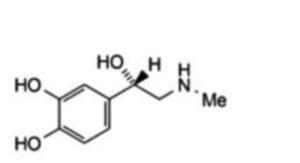
1. (1S)-1-(3,4-dihydroxyphenyl)-2-(methylamino)ethan-1-ol (D-adrenaline)
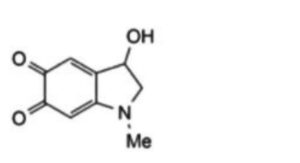
2. 3-hydroxy-2,3-dihydro1H-indole-5,6-dione (adrenochrome)