Edition: BP 2025 (Ph. Eur. 11.6 update)
Action and use
Nucleoside reverse transcriptase inhibitor; antiviral (HIV).
DEFINITION
Abacavir Oral Solution is a solution containing Abacavir Sulfate in a suitable flavoured vehicle.
The oral solution complies with the requirements stated under Oral Liquids and with the following requirements.
Content of abacavir, C28H36N12O2
92,0 to 105,0% of the stated amount.
IDENTIFICATION
A. Carry out the method for thin-layer chromatography, Appendix III A, using the following solutions in methanol (50%).
(1) Dilute the oral solution to produce a solution containing the equivalent of 0.2% w/v of abacavir and filter if necessary.
(2) 0.23% w/v of abacavir sulfate BPCRS.
CHROMATOGRAPHIC CONDITIONS
(a) Use as the coating silica gel F254 (Merck silica gel 60 F254 HPTLC plates are suitable). Before use, stand the plate in methanol, allowing the solvent front to ascend to the top of the plate, remove and heat the plate at 105° for 1 hour.
(b) Use the mobile phase described below.
(c) Apply 1 μL of each solution.
(d) Develop the plate to 7 cm.
(e) After removal of the plate, dry in a current of warm air and examine under ultraviolet light (254 nm).
MOBILE PHASE
5 volumes of methanol, 6 volumes of 13.5M ammonia, 34 volumes of dichloromethane and 55 volumes of acetone.
CONFIRMATION
The principal spot in the chromatogram obtained with solution (1) corresponds in position and colour to that in the chromatogram obtained with solution (2).
B. In the Assay, the chromatogram obtained with solution (1) shows a peak with the same retention time as the peak due to abacavir in the chromatogram obtained with solution (2).
TESTS
Acidity
pH, 3.8 to 4.5, Appendix V L.
Related substances
Carry out the method for liquid chromatography, Appendix III D, using the following solutions in 0.1% v/v of orthophosphoric acid.
(1) Dilute the oral solution to produce a solution containing the equivalent of 0.02% w/v of abacavir and filter if necessary.
(2) Dilute 1 volume of solution (1) to 100 volumes.
(3) Dilute 1 volume of solution (2) to 5 volumes.
(4) Dissolve 2.5 mg of abacavir for peak identification EPCRS(containing impurities B and D) in 10.0 mL.
(5) 0.02% w/v of abacavir impurity standard BPCRS.
(6) 0.0001% w/v of abacavir impurity 1 BPCRS.
CHROMATOGRAPHIC CONDITIONS
(a) Use a stainless steel column (15 cm × 3.9 mm) packed with octadecylsilyl silica gel for chromatography (5 μm)
(Waters Symmetry Shield C18 is suitable).
(b) Use gradient elution and the mobile phase described below.
(c) Use a flow rate of 0.8 mL per minute.
(d) Use a column temperature of 30°.
(e) Use a detection wavelength of 254 nm.
(f) Inject 10 μL of each solution.
MOBILE PHASE
Mobile phase A 0.05% v/v of trifluoroacetic acid.
Mobile phase B methanol (85%).
| Time (Minutes) | Mobile phase A (% v/v) |
Mobile phase A (% v/v) |
Comment |
| 0-20 | 95-70 | 5-30 | linear gradient |
| 20-35 | 70-10 | 30-90 | linear gradient |
| 35-40 | 10 | 90 | isocratic |
| 40-41 | 10-0 | 90-100 | column wash |
| 41-50 | 0 | 100 | column wash |
| 50-51 | 0-95 | 100-5 | column wash |
| 51-55 | 95 | 5 | re-equilibration |
SYSTEM SUITABILITY
The test is not valid unless, in the chromatogram obtained with solution (4):
the chromatogram closely resembles the reference chromatogram supplied with abacavir for peak identification EPCRS;
the resolution between the peaks due to abacavir and abacavir impurity D is at least 1.5.
LIMITS
Identify any peak in the chromatogram obtained with solution (1) corresponding to impurity C using the chromatogram obtained with solution (5) and the chromatogram supplied with abacavir impurity standard BPCRS.
In the chromatogram obtained with solution (1):
the area of any peak corresponding to abacavir impurity C is not greater than the area of the principal peak in the chromatogram obtained with solution (2) (1.0%);
the area of any peak corresponding to abacavir impurity 1 is not greater than the area of the peak in the chromatogram obtained with solution (6) (0.5%);
the area of any other secondary peak is not greater than the area of the principal peak in the chromatogram obtained with solution (3) (0.2%);
the sum of the areas of all secondary peaks is not greater than twice the area of the principal peak in the chromatogram obtained with solution (2) (2.0%).
Disregard any peak with an area less than 0.5 times the area of the principal peak in the chromatogram obtained with solution (3) (0.1%).
ASSAY
Carry out the method for liquid chromatography, Appendix III D, using the following solutions in 0.1% v/v of orthophosphoric acid.
(1) Dilute the oral solution to produce a solution containing the equivalent of 0.02% w/v of abacavir and filter if necessary.
(2) 0.023% w/v of abacavir sulfate BPCRS.
(3) Dissolve 2.5 mg of abacavir for peak identification EPCRS(containing impurities B and D) in 10.0 mL.
SYSTEM SUITABILITY
The test is not valid unless, in the chromatogram obtained with solution (3), the resolution between the peaks due to abacavir and abacavir impurity D is at least 1.5.
CHROMATOGRAPHIC CONDITIONS
The chromatographic conditions described under Related substances may be used.
DETERMINATION OF CONTENT
Calculate the content of C28H36N12O2 in the oral solution from the chromatograms obtained using the declared content of C28H36N12O2 in abacavir sulfate BPCRS.
LABELLING
The quantity of active ingredient is stated in terms of the equivalent amount of abacavir.
IMPURITIES
The impurities limited by the requirements of this monograph include those listed under Abacavir Sulfate and the following.
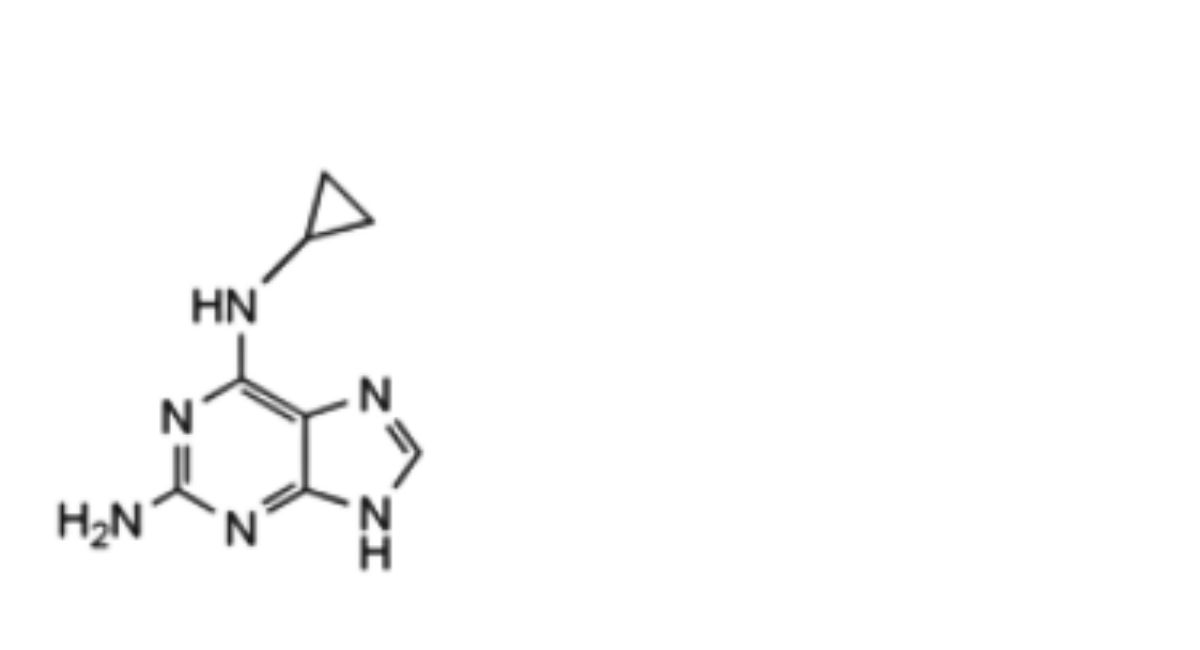
1. N6-cyclopropyl-1H-purine-2,6-diamine.